
Some memorial projects begin with a formal committee brief. Others begin with a single photograph and a simple wish: to remember someone faithfully. We have seen both. For a veterans association, municipality, museum, school, or family, how to commission a memorial statue is usually a question about trust as much as technique. Will the likeness feel right? Will the uniform belong to the correct period? Can the foundry turn an idea into a sculpture that is ready for its site?
At YouFine Bronzes Gallery, we begin by listening to the story behind the memorial. Our artists then turn the available photographs, historical clues, and chosen setting into a model that can be reviewed before bronze is cast. The process below follows that journey in the order we usually discuss it with clients. It also shows where an existing model may help, where individual research matters, and what can be decided together as the work develops.
Begin with the person, the story, and one photograph
A custom military memorial does not need to arrive as a complete design package. One clear photograph of the person is enough to start a conversation about a portrait. A photograph of the site, a description of the service member, or even a reference to a pose the family admires can help us understand the intended feeling. More views and records improve accuracy, especially for a full-length statue, but incomplete material is common in memorial work.
We first talk through what the sculpture should remember. A single figure can feel intimate and personal. A kneeling figure may convey reflection; a standing figure can suggest service or vigilance; a group composition can tell a story of shared effort. The kneeling soldier example, BOKK-481, shows how posture alone changes the tone of a memorial. Our veteran memorial gallery offers other starting points for scale and composition.

There is no need to settle every artistic choice at this first stage. We can discuss whether a familiar model is close to the desired tribute or whether a new portrait and pose should be sculpted. A good foundry should be able to explain the difference and show relevant work before the project moves forward.
Choosing a foundry: look beyond the finished photograph
When a committee compares foundries, finished images matter, but the work between the first sketch and the final bronze matters just as much. We suggest looking at the sculptors’ ability to make a recognizable face, the clarity of the clay model review, the care given to small historical details, and the quality of photographs from the actual workshop. A foundry that shows the development of a project makes it easier to understand how an idea will become a finished memorial.
Our U.S. military-theme park and museum project records ten sculptures through modeling, finishing, packing, and client feedback. It is a useful view of the work behind a group of memorial figures, while the military sculpture collection shows a wider range of individual and group formats.
It is also worth asking how a foundry handles corrections. In our workshop, the clay model is an important conversation with the client, not simply a formality before casting. Facial expression, stance, folds of clothing, and the relationship between figures can all be studied at that stage. Changes made in clay are far more straightforward than changes made after bronze has been cast.
From a known model to a personal memorial
Some organizations have already seen a composition that expresses what they want to say. An existing model can help them picture the size, posture, and emotional direction of a new commission. For example, the three-figure No Man Left Behind model, BOKK-42, conveys the bond between service members through their shared movement. We can discuss an existing model as a visual reference while keeping the authorship and any reproduction permissions clear.

A personal memorial asks for different work. The likeness, age, expression, uniform, and meaningful objects belong to the individual being remembered. Our model artists can begin with the supplied photograph and then develop the face and pose for review. An established pose may still help start the discussion, but it should never replace the research needed for a particular person or era.
How we approach historical details
In a military statue, a button, insignia, cap shape, or piece of equipment is more than decoration. These details locate the person in a period and a service tradition. Families and veterans often know them intimately. We therefore study the references available for the commission and distinguish what is visible in a photograph from what must be researched or interpreted.
One client asked us to restore the details of a service member’s clothing with particular care. Our team looked through material from the relevant period and worked through the markings on the uniform so that the sculpture would reflect the intended time and identity. We have kept the client’s project anonymous here because its identifying details are not part of the public brief. What matters to the process is the method: check the evidence, sculpt the detail, share close-up views, and refine it before the model is approved.
A related example from our workshop is the officer, firefighter, and EMS commission. This is a first-responder project, not a military memorial. It shows the same need for careful insignia work: the reference patches and symbols were compared with the details on the finished figures. For a military commission, the equivalent review may involve unit insignia, rank, ribbons, service branch, or period equipment, according to the source material available.

When a detail cannot be verified, we would rather discuss the uncertainty than quietly present a guess as fact. This is especially important when a memorial is commissioned by several families, a veterans group, or a public institution.
What if there is only a half-body photograph?
Older photographs often show only the face and upper torso. A full-length memorial is still possible, but its unseen parts require thoughtful reconstruction. We consider the visible clothing, the likely period, the person’s role, and the desired posture, then develop a proposal that the client can examine. The aim is to make the completed figure coherent while being honest about which parts come directly from the photograph and which parts were inferred.
In one commission, a client wanted a full-length statue of a soldier friend but had only a half-body photograph. We studied the clothing visible in that image and researched how the lower part of the outfit could be completed. The resulting full-body model gave the client a chance to see and discuss the interpretation before casting. That review is a gentle but essential part of honoring a real person: it allows family or colleagues to say, “This feels like them,” or to point out a detail we should revisit.
Additional photographs are welcome whenever they exist, but a single image can be a meaningful beginning. It is the foundry’s job to explain how the missing information will be handled and which decisions need the client’s eye.
From conversation to sketch and clay model
Once the subject and general direction are clear, we discuss scale and placement. A statue for a garden memorial, museum, public square, or veterans park will be seen from different distances and heights. The pedestal and inscription may be designed by the local project team, but they affect the figure’s proportions and viewing angle. Early site photographs help our artists suggest a suitable scale without demanding a complete architectural package at the outset.
The design then moves through sketches or visual references to a clay model. In clay, the committee can see the figure from multiple angles and consider the expression, posture, uniform, and overall feeling. For a group, we look at how the figures relate to one another; for a portrait, we spend more time on the face and the recognizable habits of the person. We share progress images so the people closest to the story can respond while the model is still being shaped.
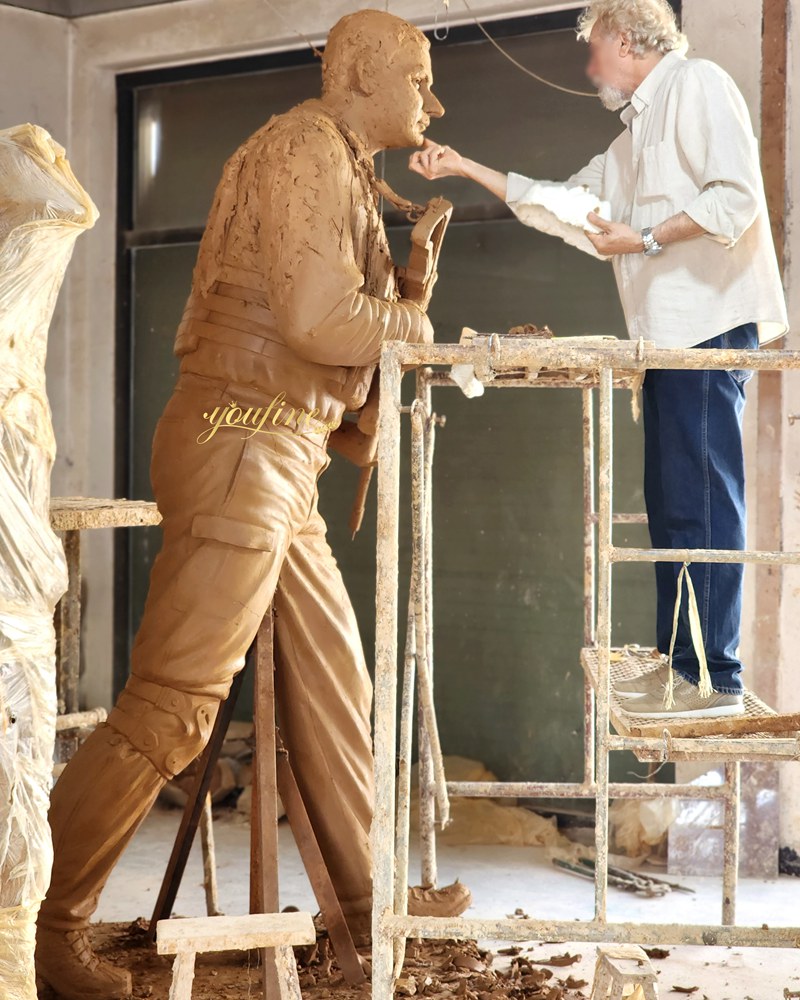
Only after the model has been reviewed do we move toward the mold and bronze. That sequence protects both the story and the practical work of the commission.
Casting the approved model in bronze
The approved model is translated into bronze through the lost-wax process. Wax reproduces the model’s surface; after a mold is prepared and the wax is removed, molten bronze is cast into the resulting space. Larger works may be cast in sections, then joined and refined by hand. The surface is chased, polished where appropriate, and finished with a chosen patina.
This is the stage where the artist’s modeling and the foundry’s casting skill meet. Good casting should preserve the expression, feathering of fabric, and small emblems that were settled in clay. Our detailed guide to how bronze statues are made shows the production sequence for anyone who wants to see the workshop steps more closely.
Before packing, we compare the finished figure with the approved model and share overall photographs and relevant close-ups. A memorial is meant to be seen for years, so the finish, visible joins, inscription relationship, and base connection deserve a careful final look.
Preparing for the memorial’s future home
A sculpture’s setting changes how it is experienced. The same figure can feel intimate beside a path and ceremonial in a large open plaza. We discuss the intended site as the design develops: whether the work is indoors or outdoors, how visitors approach it, and whether a pedestal raises the face above the viewer’s eye line. The local site owner and installer can then plan the foundation, access, anchors, and any approvals appropriate to that location.
For an outdoor work, patina and maintenance are part of the conversation too. Bronze is well suited to long-term display, but its appearance will change with weather and care. We can discuss finish samples and care information while the final sculpture is being prepared, so the organization responsible for the site knows what to expect.
Dedication dates matter deeply to memorial committees. We work backward from the proposed event with time for model review, casting, finishing, packing, transport, and installation. Because each project and destination is different, we prefer a project-specific schedule over a general promise that might not account for the site or approvals.
Real projects show different ways a memorial can take shape
| Workshop example | What it illustrates | Explore |
|---|---|---|
| U.S. military-theme park and museum project | A larger group of ten sculptures developed through modeling, finishing, and delivery. | See the project story |
| Soldier and dog, BOKK-873 | A custom figure with a personal relationship at the center; the page also includes a client photo after delivery. | See the sculpture |
| Kneeling soldier, BOKK-481 | How a quieter pose can set the emotional tone for a single-figure memorial. | See the sculpture |
| No Man Left Behind model, BOKK-42 | A known multi-figure composition that can help explain movement and companionship. | See the model |
| Officer, firefighter, and EMS figures, BOKK-821 | A separate first-responder commission showing close attention to uniform references and insignia. | See the detail work |

These examples are different in subject and purpose. The thread connecting them is the same sequence of listening, researching, modeling, reviewing, casting, and finishing. The most useful reference for a new memorial is the one that helps everyone describe what they hope the completed sculpture will communicate.
How long does a custom military memorial take, and what shapes the cost?
There is no single schedule or price that fits every memorial. A portrait made from one photograph involves different modeling work from a three-figure monument; a historically specific uniform may need more research than a general commemorative figure. Scale, number of figures, complexity of the pose, finish, pedestal interface, transport, and the pace of client review all affect the plan.
When we understand the photograph or idea, the preferred setting, and the approximate scale, we can describe a realistic path for that particular project. A committee can then see where decisions happen before fabrication and where local installation work enters the schedule. This is especially helpful when the dedication date is already known.
A gentle place to start
If your organization is considering a military memorial statue, a photograph and a few words about the person or story are enough to begin. If there is already a site, a picture of it is useful too. We can discuss the right form, show relevant models and past work, explain what can be confirmed from the available references, and outline the next design step. Share the story with our foundry when you are ready; the memorial can take shape through conversation.